Terminal Crimping Machine Buyer Guide: Presses, Applicators and Quality Control
Crimping joins a terminal to stripped wire by deforming the terminal barrel tightly around the conductor. A good crimp is gas-tight, mechanically strong and electrically stable; a bad one looks fine to the eye but fails in the field through vibration, heat or oxidation. This guide explains how terminal crimping machines are built, what separates a bench crimping press from an automatic crimping line, and how to specify the correct machine for your terminals. It pairs naturally with our wire cutting and stripping guide, since most crimping stations sit directly after stripping.
How a crimped joint works
A terminal has two barrels: the wire barrel grips the conductor, and the insulation barrel supports the insulation to relieve bending stress. During crimping, a shaped die collapses the barrel into a controlled profile - commonly a B-crimp (also called an indent crimp) for discrete terminals or a hexagonal crimp for tubular lugs and large cable. The two most important process values are:
- Crimp height - the measured height of the finished barrel, which defines compression and is the primary setting operators adjust.
- Pull-out force - the force needed to pull the wire out of the terminal, checked with a terminal tensile tester against your terminal supplier's standard.
Too little compression leaves voids and high resistance; too much cuts strands or work-hardens the terminal. Crimp quality is verified by cross-section analysis during process development and pull testing during production.
Machine type 1: pneumatic and manual bench presses
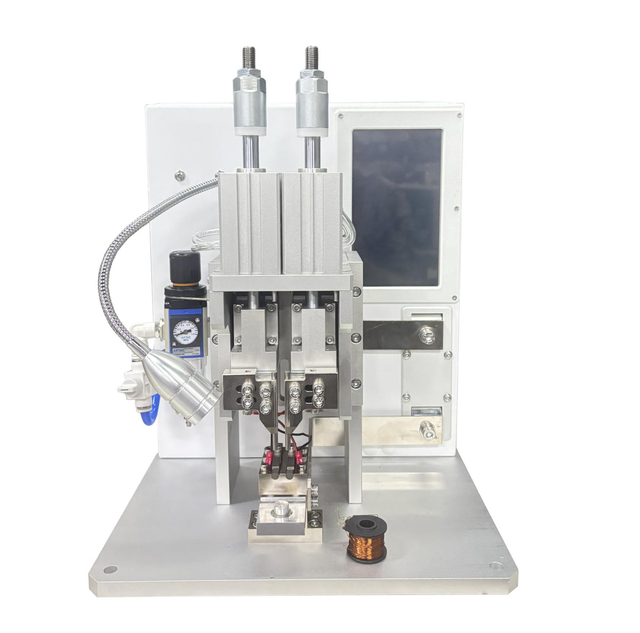
A bench crimping press provides a vertical ram stroke; the terminal and stripped wire are positioned by hand, and a pneumatic cylinder (or manual lever on small units) drives the stroke. These presses are low cost, quiet and flexible - changing products means changing the quick-change applicator or die set rather than the machine. They suit low-to-medium volumes, frequent terminal changes, workshops and repair stations. See the pneumatic terminal crimping machines.
Machine type 2: semi-automatic terminal crimping machines
A semi-automatic machine consists of a motorized press, an applicator (the feed mechanism that advances terminals from the reel in step with the ram) and a crimping die. The operator feeds stripped wire into position; the machine feeds, crimps and cuts the terminal from its carrier strip automatically. Mute (low-noise) designs reduce operator fatigue. The same press accepts different applicators, so one machine can run many terminal part numbers - browse the semi-automatic terminal crimping range.
Machine type 3: automatic cut-strip-crimp lines
For high volumes, fully automatic machines cut wire from a reel, strip both ends and crimp terminals onto one or both ends without manual handling. Dual-end versions crimp different terminals on each side; five-wire machines process several conductors simultaneously for ribbon and multi-core cable. These lines are the standard for appliance and automotive harness production, where cycle time and consistency across millions of joints dominate the cost calculation.
Machine type 4: heavy-lug and special-purpose crimpers
Large tubular cable lugs, copper-aluminum terminals, hex-crimped battery cable ends and RJ45 connectors do not fit a standard applicator. They use hydraulic or high-tonnage presses with matched hexagonal or shaped dies, and separate machines exist for RJ45 plug crimping. If your range includes large power cable, see the terminal crimping machine category and confirm the cross-section range with the factory.
The applicator is as important as the press
Operators new to crimping sometimes buy a press without understanding that terminal feeding is done by the applicator, which is built around a specific terminal carrier strip and pitch. Key points:
- Send physical terminal samples or the terminal drawing - barrel dimensions, strip pitch and material thickness determine the applicator design.
- Quick-change applicators (such as OTP/standard-mount frames) allow a shared press across many terminals, with changeover measured in minutes.
- Flag terminals, insulated terminals, sealed terminals and waterproof plugs often need dedicated feed guides or seal insertion stations.
- The crimping die profile must match the terminal supplier's specification; reusing the wrong die is the most common cause of rejected crimps.
Pneumatic, servo or mechanical drive?
| Drive | Characteristics | Best fit |
|---|---|---|
| Pneumatic | Simple, low cost, needs clean compressed air; force set by pressure | Benchtop stations, small-to-medium terminals, varied work |
| Mechanical (motor/flywheel) | High speed, consistent stroke, lower per-crimp cost at volume | Semi-automatic reel-fed production |
| Servo / electric | Programmable stroke and position, energy saving, quieter, supports force monitoring | Precision, mixed terminals, automated lines |
Quality monitoring options
For safety-critical harnesses (airbags, braking, medical), consider a crimp force monitor (CFM): a sensor compares the force signature of each crimp against a learned good curve and flags missing wire, missing strands, wrong terminal or worn tooling immediately. Combined with periodic pull tests and cross-section samples, a CFM turns a batch process into one with per-joint traceability.
What to prepare before requesting a quote
- Terminal samples and the manufacturer's drawing, including strip form, pitch and plating.
- Wire range: smallest and largest cross-section, conductor and insulation dimensions.
- Required crimp standard or pull-out force, and whether cross-section reports are needed.
- Daily volume and number of terminal part numbers (how many applicators?).
- Whether terminals arrive on reels, loose or in strips, and whether seals must be inserted.
- Power available and whether the machine must integrate with a cut-strip line or PLC.
Frequently asked questions
Can one machine crimp many different terminals?
One press can run many terminals if each terminal family has its own applicator and die set. Quick-change frames keep changeover short. Truly different terminal styles - for example flag terminals and large tubular lugs - usually require different machines.
How do I know the crimp is correct?
Set crimp height to the terminal specification, then verify with pull tests and cross sections. The conductor should fill the barrel without exposed cut strands, the insulation grip should support the jacket, and the bell mouth and brush length should meet the drawing.
Do I need a crimp force monitor?
For general electronics, disciplined sampling and pull testing are usually sufficient. When a single bad crimp has safety or warranty consequences, a CFM is inexpensive insurance and is increasingly required by automotive suppliers.
Can you supply applicators for our existing terminals?
Yes. Send the terminal samples or drawings with wire and strip specifications; applicators and dies are built to the terminal geometry and tested before delivery. Custom functions and seals can be developed for specific processes.
Send your terminal drawings and wire samples to request a tested crimping solution within 24 hours, or continue with our cable coiling and binding guide for the packaging stage after processing.
Need a machine for this wire process?
Send your wire sample, cable drawing or production target. Our engineers test it and reply with a machine recommendation within 24 hours.