JW-05KA Precision Inverter Spot Welder: Complete Buyer Guide
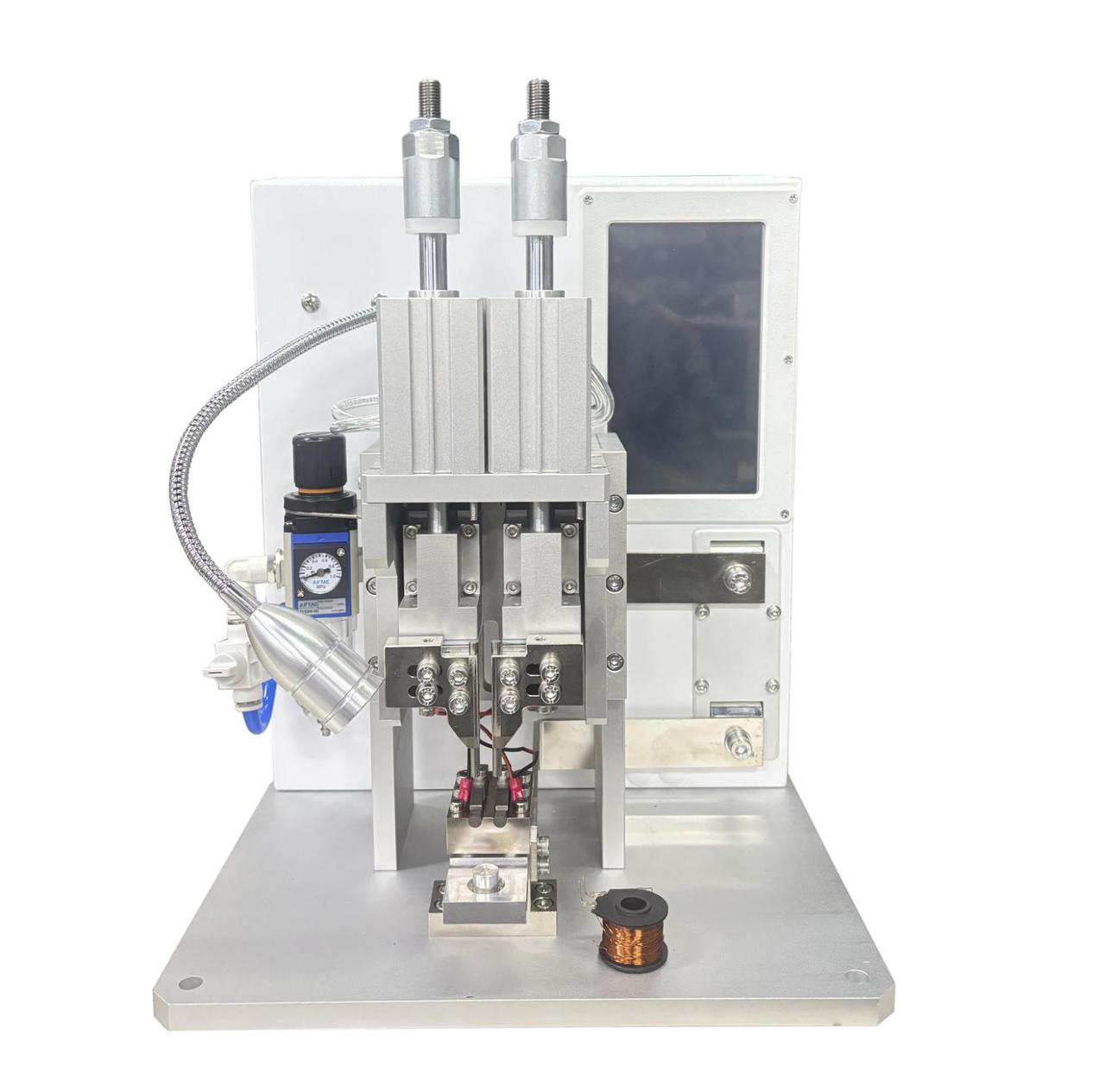
Precision inverter spot welders are used where an ordinary AC welder cannot deliver stable results: thin copper wire, small battery tabs, delicate electronic components and other joints that need tightly controlled heat. The JW-05KA precision inverter spot welder combines a 5,000 A medium-frequency DC power supply with a rigid, fast-following welding head, plus closed-loop monitoring and 90-day weld-data logging. This guide explains how the machine works, what the specifications mean in practice, and how to decide whether it fits your welding process.
What is a precision inverter spot welder?
A conventional AC spot welder switches mains-frequency current directly through a transformer. An inverter (medium-frequency DC) welder instead rectifies three-phase input, converts it to a medium-frequency current, and rectifies it again at the transformer into DC. The practical differences for production are significant:
- Much faster control. Welding current is adjusted within milliseconds, so each weld receives the energy you programmed rather than what the grid happened to deliver.
- Lower, more concentrated heat. DC current has no zero-crossing gaps, which shortens weld time and reduces heat spread into surrounding parts - important when welding near plastics, insulation or sensitive components.
- Stable output on a fluctuating factory line. The JW-05KA compensates supply-voltage fluctuations and adapts to grid frequency, and protects itself with built-in over-temperature monitoring.
- More efficient and compact. The inverter transformer is far smaller than an equivalent AC welding transformer.
JW-05KA technical specifications
| Parameter | Specification |
|---|---|
| Model | JW-05KA |
| Input voltage | 3~380 V, three-phase |
| Rated power | 28 kVA |
| Maximum output current | 5,000 A (DC) |
| Current control modes | Constant current / constant voltage / constant power / mixed control |
| Duty cycle | 10% |
| Inverter frequency | 1 / 2 / 4 kHz |
| Welding cycle stages | 3 |
| Number of welding pulses | 99 |
| Stored welding schedules | 99 sets |
| Current up-slope / down-slope | Yes, independently adjustable |
| Dimensions (L x W x H) | 425 x 320 x 380 mm |
| Weight | 27 kg (power supply) |
Each JW-05KA is delivered as a complete set: one precision inverter welding power supply, two sets of welding electrodes, and the matched welding head with pneumatic components.
Closed-loop control: constant current, voltage and power
A high-speed DSP controller runs a fully closed loop in constant-current, constant-voltage, constant-power or mixed mode. Instead of trusting a setting on a dial, the machine measures the actual output on every weld and corrects it in real time. You can set upper and lower current limits directly - no reference-value conversion is needed - and the machine raises an alarm when a weld falls outside the window. The current waveform can be observed at intervals as short as 0.5-1 ms, which is the level of visibility required when qualifying a new process or troubleshooting spatter or weak joints.
Three-stage heating, ramps and 99 schedules
The welding cycle is built from three heating stages with independent current up-slope and down-slope. Time can be set across a wide range (0-250 ms or 0-1 s), and each program can use its own welding frequency between 800 Hz and 5 kHz. Up to 99 pulses per cycle and 99 stored schedules let you preheat delicate material, form the nugget, then temper it - or switch instantly between products on a mixed line. The ramp-up speed is independently adjustable, which matters when welding work-hardened or coated materials that respond poorly to an instantaneous current surge.
The welding head: rigidity and follow-through decide weld quality
Even a perfect power supply cannot compensate for a head that drifts or follows slowly as the metal collapses. The JW-05KA head is machined from duralumin as a rigid structure engineered to hold alignment even during long periods of high-force welding. Vertical travel runs on a slider-and-linear-rail mechanism for precise, repeatable electrode motion, while an adjustable-stroke AirTAC cylinder combined with a spring delivers stable pressure and fast follow-through at the welding instant.
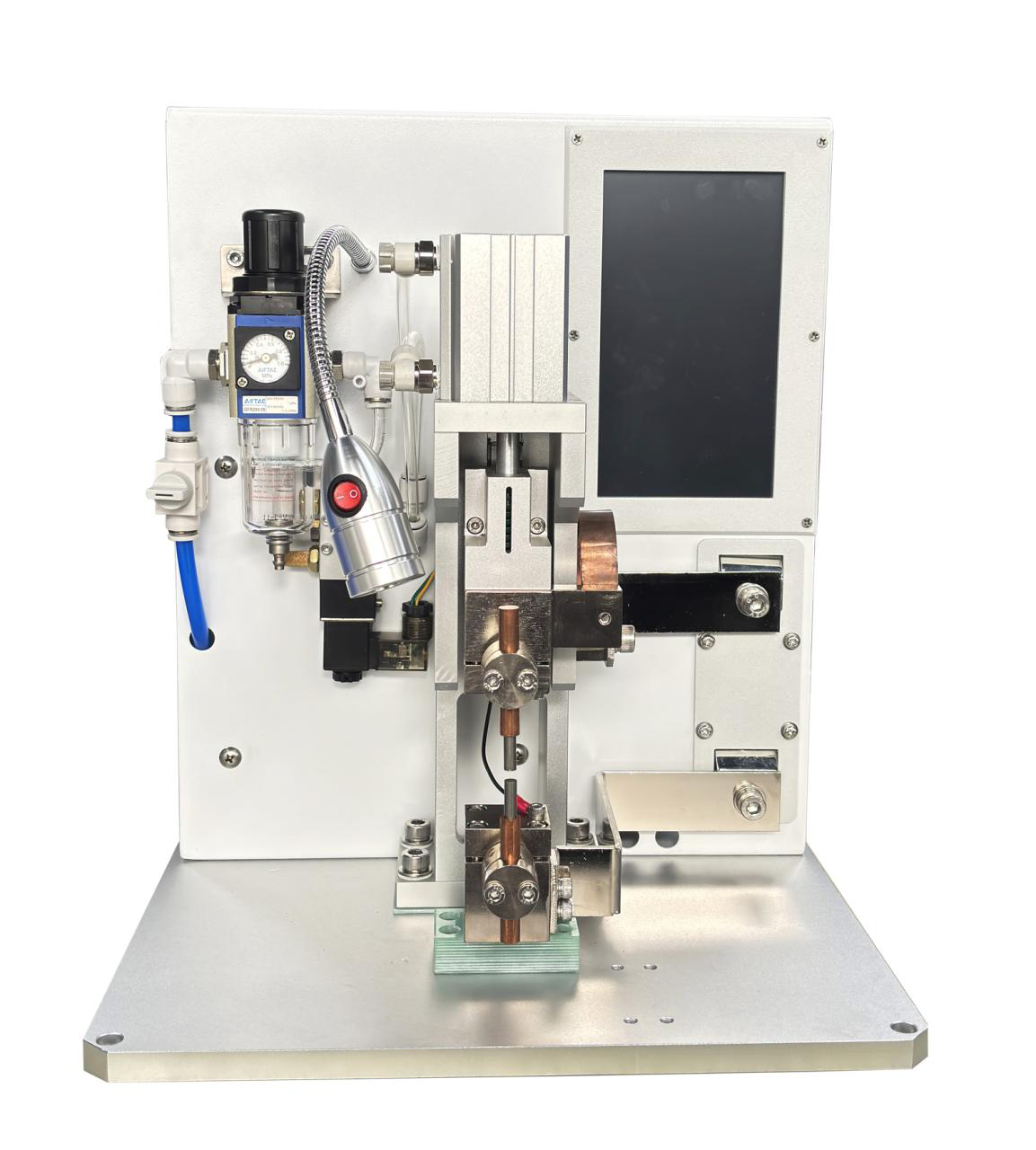
Good follow-through is particularly valuable in low-force welding, where slow head response produces weak or inconsistent nuggets; it also reduces electrode wear. Key pneumatic parts use brand-name components for easy worldwide maintenance - an AirTAC SDA32x40 cylinder, GFR200-08F1 pressure-regulating valve, SP110 solenoid valve and AirTAC LSH15HN linear rail. A pressure sensor can be fitted to the head to display the pressure waveform in real time.
Traceability: 90 days of weld data
For medical, automotive or battery-pack work, weld records are often part of the quality system. The JW-05KA stores up to 90 days of weld-spot parameters internally. An open USB port allows the data to be retrieved at any time and exported directly in universal Excel format - no conversion software is required. The built-in weld-spot counter also counts completed spots, totals workpieces based on a preset spots-per-piece value, and reminds the operator when the electrode tip is due for dressing or replacement, which protects weld quality before tip wear starts causing rejects.
Automation-ready communication
The controller provides weld-end and fault signals as standard, with optional RS-232 / RS-485 data ports for integration into automated welding lines. Custom control functions can be developed for specific process requirements, so the same power supply can move from a benchtop station to a PLC-driven fixture without changing platforms.
Typical applications
- Lead wires and terminations on small coils and electromagnetic components
- Copper braid, stranded wire and thin copper-sheet connections
- Nickel-plated strips and tab connections on small battery assemblies
- Brass, copper and coated terminals in switches, relays and sensors
- Precision electronic parts where heat must stay local to the joint
Because weld results depend on the exact material combination, plating, thickness and geometry, we recommend confirming every new application with a physical sample rather than comparing current ratings alone.
How to specify the right spot welder
Before requesting a quotation, collect the following information:
- The two (or more) materials to be joined, including plating and thickness of each layer.
- The joint geometry and the space available for electrode access.
- Required weld strength, resistance or pull-test standard.
- Cycle time and daily production volume.
- Whether weld-data logging, pressure sensing or RS-232/RS-485 automation is required.
Send these details - or simply the physical samples - and our engineers will run weld tests, recommend the electrode configuration, and return a machine setting sheet with the quotation within 24 hours.
Frequently asked questions
What is the difference between the JW-05KA and a cheaper AC spot welder?
The JW-05KA offers millisecond-level closed-loop control in constant current/voltage/power modes, up/down-slope heat profiling, current-limit alarms, per-weld waveform monitoring and 90-day data logging. An AC welder is typically open-loop and cannot provide the same repeatability on thin or dissimilar materials.
Can it weld copper?
Yes. The 5,000 A DC output and fast-following head are designed for high-conductivity materials such as copper and copper alloys, which need high current in a very short time. Exact settings always depend on your material stack-up, which we verify on samples.
How many welding programs can be saved?
The controller stores 99 welding schedules, each with its own three-stage heating profile, pulse count, frequency and ramp settings.
Is the machine suitable for an automated line?
Weld-end and fault signals are standard, and RS-232 / RS-485 communication is available as an option. The head can also be adapted to custom fixturing for integration with PLC-controlled automation.
Need a machine for this wire process?
Send your wire sample, cable drawing or production target. Our engineers test it and reply with a machine recommendation within 24 hours.